Current Projects

AK: A Project

On the Work of Annson Kenney (1944–1981)

Annson Kenney (1944–1981) was a Philadelphia writer and artist who crossed boundaries and left a luminous mark in his wake. Annson produced music-theater spectacles, constructed art-language objects, played and composed music. Coming of age through the late 1960s, he challenged everyone around him with body art, conceptual art, performances, art criticism and talk as fast and funny as the night was long.

Raised in the Frankfort sections of Philly, he took his Catholic School education lightly and was drawn to art and ideas on the intersections of vernacular subjects spiked with theoretical energetics. Stylistically, he pulsed with a high/low gambit that led him to write, in purposely posturing prose, essays on haircuts, roller derby, Marcel Duchamp and the semiotics of musical notation. He found signs worth penning about in female wrestling and drag racing. He bought a fast car that he never drove but died in a car crash anyway one New Year's Eve eve before the unsettling 1980s settled in on us.

Language and wordplay, writing and sign systems, the sacred and profane of everything and relations between the body, sight and sound were among his most consistent themes. He worked with neon for a decade — or, as he preferred to call it, luminous tubing. He created over 100 works, some for commercial businesses, and had sketched out plans for dozens more. In the most basic sense, Annson had the conception of transforming walls (in galleries, museums, homes) into planes for writing that glowed and torqued seeing into reading, ideas into hotter ideas.

This was all before the Internet and webpages, which are too tame for his kinetic intelligence and combative aesthetics. But he would have figured out something and there is no telling where he would have gone as an artist. For those of us who knew him, the memories have never faded. Annson and I had luminous times and talked a lot. As I put together some pages on him, I hope to convey some of what he did.

The Handwriting on the Wall

It is as if what he was doing was as evident as 'the handwriting on a wall,' a sentiment which he rendered with characteristic irony in a neon work with the title Pidgin Tongued. The common saying about what you see is obvious when it is written is derived from a brief scene in 'The Book of Daniel' in the Old Testament. It refers to an act of interpretation by Daniel for the Babylonian King Belshazzar, who was unable — or incapable — of figuring out the meaning of the words mene mene tekel upharsin which were written on a plaster wall by 'the fingers of a man's hand' and became either a hallucination by the drunken King or an otherworldly message directed at him.

Annson, keen to the sounds of the phrase, remade it as many many tinkle a parson, which is slightly funny to say but no less complicated to unravel once you know the backstory. The Biblical episode itself seems as if it had been ready made for Annson's critical and performative fascination with the hand and gestures, the acts of artmaking and writing and, of course, language play, codes and identity.

Over the years, he created analogous works, including: a sound/body art performance for radio titled One Hand Clapping (1973); and another for voice and performer, I'll Huff and I'll Puff and I'll Blow Your Impedance Match Down (1975), in which he wrote on a blackboard and amplified the screeching sound of the chalk. Other neons — including Gregg Shorthand (1975), Seventeen Strokes (1975), 12 Strokes (1975), Double Cross (1975) — are also based on hand movements in different contexts. In an unrealized design for one, he conveyed his ideas on how hand, eye and mind were not always in sync with a simple slash mark: gesture/get sure.

Briefly, as written in chapter five of 'The Book of Daniel,' the King held a great feast with his wives, concubines and lords. While drinking from vessels he had inherited, he began praising the gods of gold, silver, stone, bronze, iron, wood and stone. At that moment, 'the fingers of a man's hand appeared and wrote on the plaster of the wall of the king's palace, opposite the lampstand; and the King saw the hand as it wrote.' Frightened and knowing that Daniel, a Jew who was the son of King Nebuchadnezzar and considered a wise man, had interpreted dreams for his father, he was summoned to read and interpret the words. Daniel was also known as Beltshazzar and his two names suggest an ambiguous identity hinted at in Annson's rather plain neon sign.

In Daniel's interpretation of King Belshazzar's vision, he sees signs that the King's reign was soon to end by the hand of God. The writing on the wall, mene mene tekel upharsin, which the King considered to be nonsense, were words actually known to Daniel. They were for weights and counting and when put together, formed an arithmetic metaphor. That is, mene is a 'mina' or means 'to number,' tekel, is a 'shekel' or 'to weigh,' and parsin is 'two half-minas' or 'to divide.' As Daniel explains, the dream meant that the King, his own Father and the previous rulers had diminished and divided their wealth, and thus their legitimacy and power. Worse, they had not honored the Lord of Heaven, the true God of the Jews, and instead worshiped idols. In sum, they had been 'weighed in the balances and found wanting' by God. Thus, it will come to pass that the Babylonian kingdom will be destroyed.
" is Achieved by Formal Disfiguration of the Code."

Selected Works — Luminous Tubing

Pidgin Tongued

1976

14″ × 42″ / 14″ × 56″

Argon in Clear Glass

Annson was not impressed with the quality and aesthetic use of neon in a series of works by artist Bruce Naumann. Taking things into his own hands, he fashioned a stylized epigrammatic taunt that, in its title and content, expressed his critique.

Bruce Naumann, Cramped for Style

1975

46″ × 28″

Argon, Mercury Vapor in Blue Bromo Glass, with mirror

In the piece, he appropriated a school kid's writing puzzle. The barely legible elongated letters of the artwork spell out what might be the effort involved in physically writing them; and when seen in a mirror set behind the luminous tubing, the phrase is readable. The child's play relates both to his other works and overall themes bearing on language, writing, reading, speech and performance.

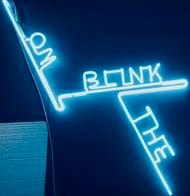
PARSE / On the Line / On the Blink

1980

37″ × 18″

Argon, mercury vapor, coated tubes. From the series Structuring the Syntagm.

Reed-Kellogg diagrams often used to teach writing. Not content with the regulation of penmanship and spelling, English teachers and grammarians decided that a useful method to teach writing would be to visually depict sentences in odd stick figure diagrams. Annson took the idea to extremes in luminous tubing, suggesting dozens of short and long sentences for treatment. No doubt nuns and other teachers appreciated his appropriation of diagramming, though probably not those in his series PARSE which diagrammed phrases such as: Free, White and Twenty-One; In the Pink; Get Bent.

Seventeen Strokes

1975

12″ × 62″

Argon in Fluorescent Blue Glass

Seemingly in a scripted code, Seventeen Strokes discloses Annson's research into the physical mechanics of writing and the representation of language. Like other pieces — Trace (1973), Gregg Shorthand (1974, 1975), Bruce Naumann Cramped for Style — its focus is on the movement of the hand and putting the reader in the position of simultaneously reading and 'decoding' the image. A source for the piece is a 1975 Harper's Magazine article describing a process for standardizing handwriting in 19th century England. A related work is A Stroke Book (1977): a folded and stapled 8½″ × 11″ graph paper booklet in which a type of line (drawn, ruled, etc.) is represented on each page.

Footnotes to Footlights

1975

37″ × 13″ / 19″

Argon, mercury in clear glass

Literally footnotes from a page in Joseph Kosuth's influential essay, 'Art After Philosophy' in Art International, 1969. The footnotes Annson selected are from the philosopher A.J. Ayer's Language, Truth and Logic, which Kosuth draws on to formulate his own conclusion that 'Art indeed exists for its own sake' and 'Art is the definition of art.' Which suggests, for Annson, that, analogically, 'footnotes exist for their own sake' and 'footnotes are the definition of footnotes.' Annson's title indicated what the work plainly is. Language. Truth. As for Logic — isn't it a form of language art?

The texts, artworks, videos, music, and in his aesthetic self-fashioning in life and live performances as Annson Kenney — and a few akas such as Blackie Carbon and Hender Hayman — comprise an oeuvre that intimates that a biography will be needed to account for the narratives of his incomplete and too damned brief life.

His works and the archival bits and pieces that remain are rife with clues, anecdotes and gestures that pose unanswered/unanswerable questions and latent mysteries, nearly all of which were, in one sense, hidden in plain sight if his critics — and friends — would have paid closer attention. Perhaps, eventually what he was up to would have been as lucid as the clear glass he used for his luminous tubing, though not any less ludic or brilliant.